Every automated insulin delivery (AID) system has adjustable settings to optimize glycemic control. In some systems, an adjustable target is the most impactful lever to pull. In Control-IQ+ technology, Correction Factor has the greatest impact on mean glucose.
For individuals aiming for lower mean glucose levels or who are experiencing frequent hyperglycemia, strengthening the Correction Factor can optimize basal and bolus in one simple tweak and help improve time in range (TIR) without increasing the risk of hypoglycemia.1
Correction Factor is the most impactful setting because it influences all aspects of insulin delivery – basal delivery, AutoBolus, and user-given boluses.
Impact on bolus: A stronger Correction Factor allows once-hourly AutoBoluses* to be more impactful and bring down hyperglycemia faster
Impact on basal: A stronger Correction Factor reducess constraints and allows for more dynamic basal insulin delivery
Stronger Correction Factor Resulted in Maximized TIR Without Increasing Hypoglycemia1
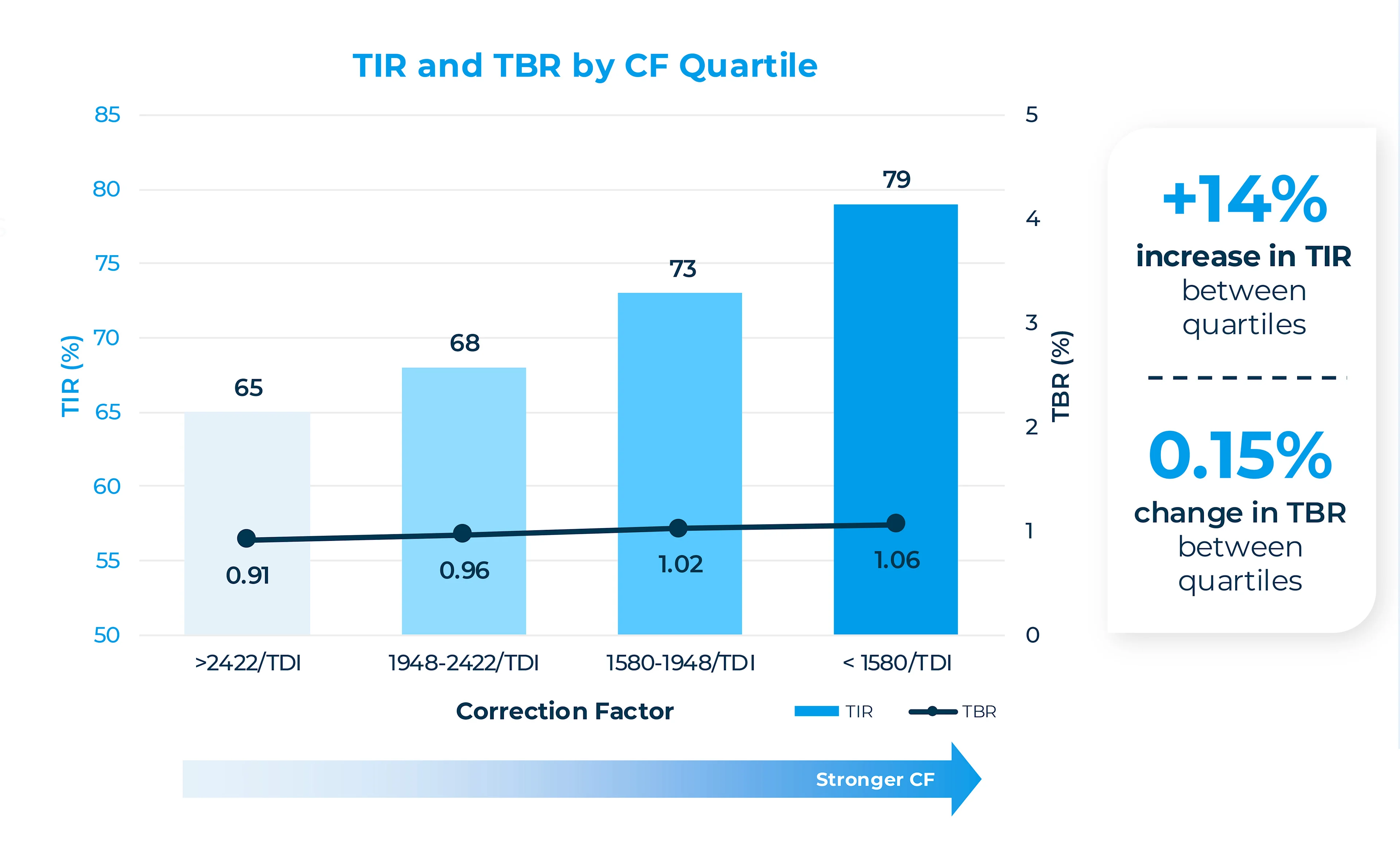
Results from a retrospective analysis of data from 22,000 users of Control-IQ+ over 3+ months of real-world use. Basal and insulin:carb ratios were also associated with higher TIR, but slightly higher time <70 mg/dL.
Practical Application:2
When starting a patient on Control-IQ+, whether coming from MDI or another AID system, it is recommended to start with a Correction Factor calculation of </= 1700/TDI. Starting settings can be more conservative as long as early optimization (day 3-14) is prioritized.
A stronger Correction Factor of <1580 is associated with higher TIR without increasing time below range. Remember, for Correction Factor, the lower the number, the stronger the setting.
For patients who struggle with mealtime bolusing, an even stronger Correction Factor can help maximize the impact of AutoBolus to account for missed mealtime insulin (e.g., <1500/TDI).
*If glucose values are predicted to be above 180 mg/dL, Control-IQ+ technology calculates an AutoBolus using the Personal Profile settings and a target of 110 mg/dL and delivers 60% of that value.
References:
Messer LH and Breton MD. Therapy settings associated with optimal outcomes for t:slim X2 with Control-IQ Technology in real-world clinical care. Diabetes Technol Ther. 2023;25(12):877-882.
Shah VN, Choudhary P, Halperin I, Rabbone I, Zaharieva DP, Messer L. Rethinking control-IQ+ technology: Simple strategies for easy optimization. Diabetes Obes Metab. 2026;28(5):3502-3514. doi:10.1111/dom.70500